Compass Deviation vs. Variation: What Every New Sailor Gets Wrong
Two boats leave the same harbor on the same tide, bound for the same buoy six miles offshore. The first steers 042° on the compass and arrives a quarter mile to the east. The second steers 042° and arrives a quarter mile to the west. Nobody on either boat was careless. They simply corrected for different things — or corrected for the same thing twice — and the sea kept the receipt.
Variation and deviation both push a compass needle away from where you want it. They are measured in the same units, spoken in the same east-or-west language, and applied with the same sign convention. That resemblance is exactly what trips people up. One belongs to the planet. The other belongs to your boat. Get them straight once and the arithmetic becomes automatic for the rest of your sailing life.
Two Errors, One Symptom
Magnetic variation is a property of where you are. It is the angle between true north and magnetic north at your position on the globe, and it changes slowly as the magnetic poles wander. Deviation is a property of what you are standing in. It is the angle between magnetic north and the north your compass actually points to, created by the iron, steel and electrical current aboard your own vessel.
Stand on a dock in the same harbor and your compass has variation but no deviation. Step aboard and swing the boat through 360° and the variation stays put while the deviation changes with every heading. That is the cleanest way to tell them apart in your head: variation follows the chart, deviation follows the boat.
Variation: The Planet's Contribution
Magnetic north sits somewhere in the Canadian Arctic and does not coincide with the geographic North Pole. The offset between the two, at any given spot, is the variation — also called declination, particularly in North America. In some parts of the world it is close to zero. In others it climbs past fifteen or twenty degrees. Off the US East Coast it runs well into double digits west; in the Pacific Northwest and New Zealand it turns the other way and runs east. A few degrees either way is enough to matter by the time you have sailed ten miles.
Reading the compass rose properly
Variation is printed inside the compass rose on a paper chart, along with an annual rate of change and the year it was measured. A typical rose might read something like “9° 15′ W 2018 (8′ E)”. That means variation was 9°15′ west in 2018 and is drifting eastward by eight minutes of arc a year. Eight years later that is roughly 64 minutes, or about 1°04′, of change — bringing variation down to somewhere around 8°11′ W. Charts are often a few years old. Do the small piece of arithmetic, or use a current value from a reputable source, rather than taking the printed number at face value.
One further wrinkle: most chartplotters display bearings in true, because that is what the chart uses. Your compass reads in magnetic. The conversion happens in your head, on paper, or inside the electronics that drive an autopilot — but it has to happen somewhere.
Deviation: Your Boat's Contribution
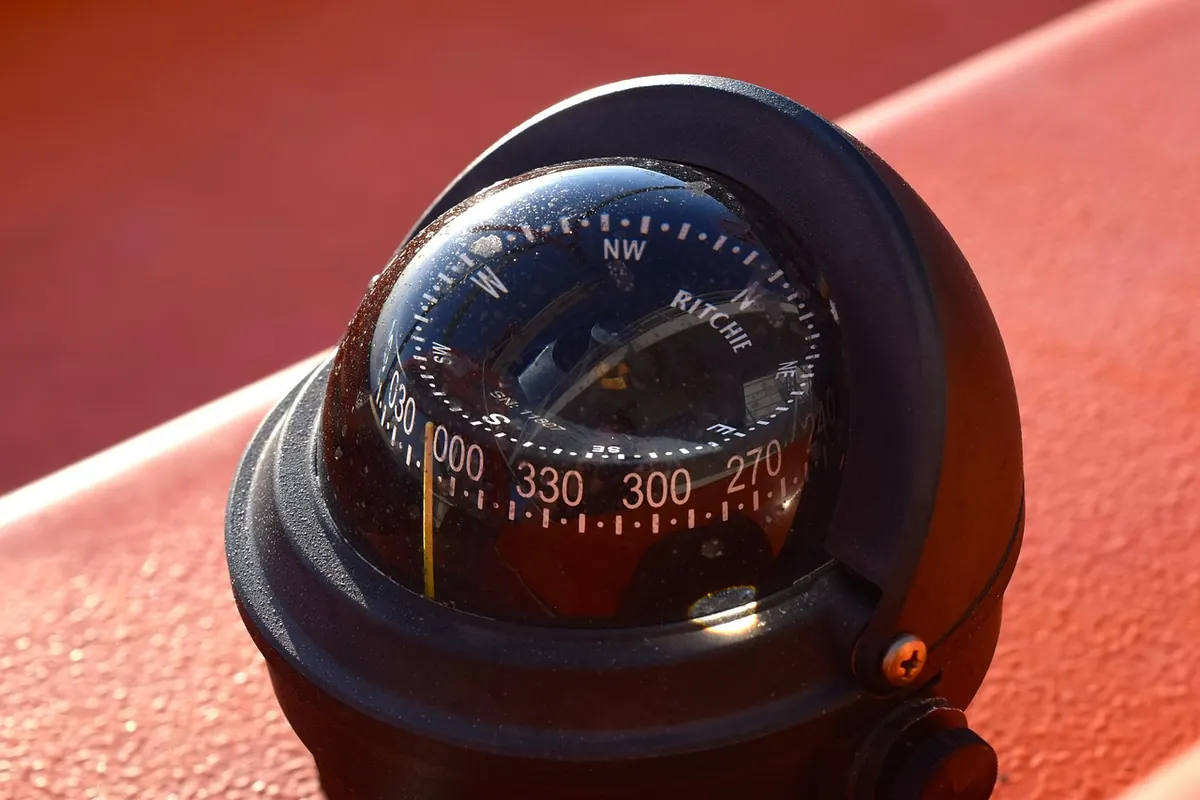
Almost every boat carries a small magnetic field of its own. The engine block, the tools in the chart table, a steel-hulled yacht, keel bolts, the autopilot drive motor, wiring carrying heavy DC current, a pair of speakers mounted either side of the binnacle. Any of these can deflect the compass card a few degrees from magnetic north.
The awkward part is that deviation is not a single number. The boat's field interacts with the earth's field differently as you turn, so deviation at 090° is not the same as deviation at 270°. Heeling changes it too. This is why a compass is “swung” — the boat is turned slowly through a full circle, ideally by a professional adjuster using a known transit or the sun, and the residual error on each heading is recorded on a deviation card taped beside the compass.
A good adjuster can reduce deviation by placing small corrector magnets around the compass, but rarely eliminates it. The card is not a failure of the adjustment; it is the honest record of what remains.
Getting the Order and the Signs Right
The chain runs True → Variation → Magnetic → Deviation → Compass. Old exam mnemonic: True Virgins Make Dull Company. Going the other way, from what the compass says back to the chart, the chain reverses.
The sign rule is simple if you say it out loud: from true to compass, add westerly and subtract easterly; from compass to true, add easterly and subtract westerly. Pick one direction and always work that way until it is second nature.
Here is a worked example. The chart gives a true course of 087°T to a waypoint. Variation is 9°W. Your deviation card shows 3°E on a heading near 090°.
- True course: 087°T
- Apply variation — westerly, so add: 087 + 9 = 096°M (magnetic)
- Apply deviation — easterly, so subtract: 096 − 3 = 093°C (compass)
- Steer 093° on the compass
Working backwards to check: 093°C plus 3°E of deviation gives 096°M; 096°M minus 9°W of variation gives 087°T. The loop closes, which is exactly what you want before you commit to a heading in a narrow channel.
Where New Sailors Come Unstuck
- Applying variation on top of variation. If the plotter already converted its bearing to magnetic and you subtract nine degrees again, you have doubled the error.
- Using the deviation for the wrong heading. The card lists a value per heading because the value changes per heading. Reading the row for 270° when you are steering 090° is a real and common slip.
- Assuming the card is still valid. New electronics, a different anchor, a speaker relocation or a toolbox in a new locker can all rewrite it. Deviation is perishable.
- Confusing course over ground with heading. A GPS shows where you actually went. In current, that can differ from where you pointed by a wide margin. It is not a compass check.
- Leaving a phone or tablet beside the binnacle. Speakers and magnets in consumer devices deflect a small boat compass more than most people expect. Keep them a sensible distance away.
Checking the Compass at Sea
You do not need a professional swing every season. On a calm day with little current, point the boat along a known transit — two charted marks in line — and note what the compass reads against the transit's true bearing. Compare that with what your arithmetic predicted. A steady difference across several headings means the card has drifted. A large error confined to one heading usually points to something magnetic that has moved aboard.
Hand bearing compasses carry their own deviation, particularly when you hold one near the rigging, a metal dodger frame or a winch. Take your bearing from the same spot each time, standing clear of ironwork.
A Two-Minute Pre-Departure Compass Routine
Before you cast off, run through this in order. It takes less time than coiling a halyard.
- Read the variation from the chart rose, apply the annual change, and note the figure.
- Check the deviation card is legible, current, and shows a value for the heading you expect to steer most.
- Convert your first planned true course all the way down to compass and write the number on the chart or a note card.
- Clear magnetic clutter away from the binnacle and confirm nobody has left a tool bag against the bulkhead beside it.
- At the first safe opportunity, cross-check against a transit and see whether the compass agrees with your arithmetic.
Do this often enough and you will stop thinking of variation and deviation as a pair of corrections and start seeing them for what they are: two separate, knowable facts — one about the world, one about your boat. The needle is doing its best. Your job is to know precisely why it is pointing where it points.
Photo: Сослан / Pexels